
Summary
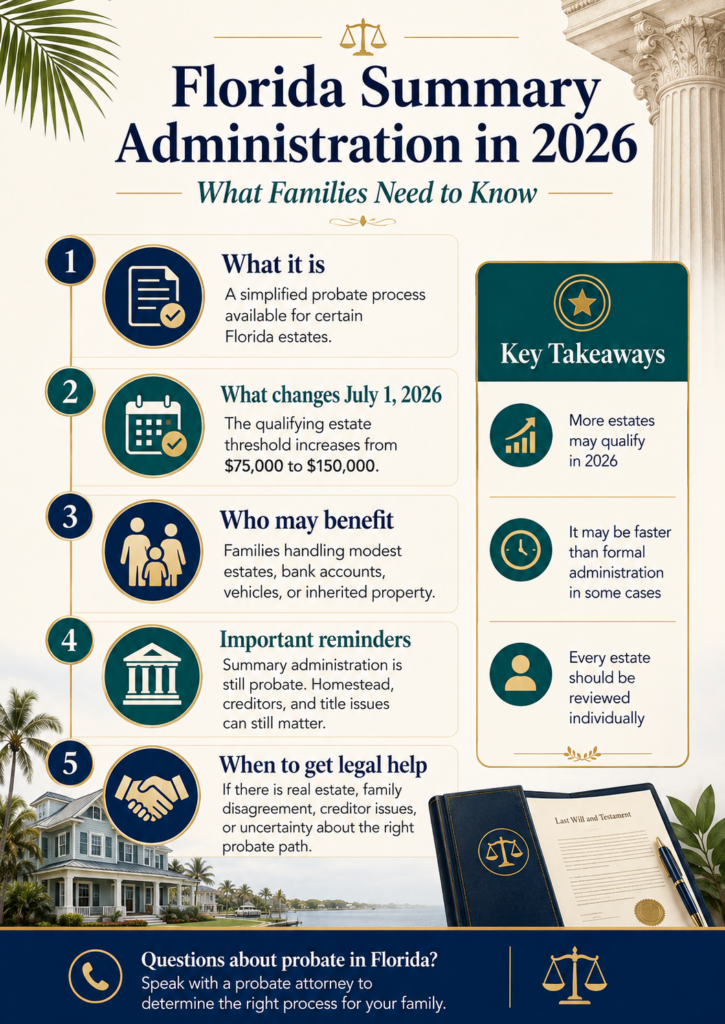
Beginning July 1, 2026, Florida’s summary administration rules are changing. The qualifying estate value threshold increases from $75,000 to $150,000, which may allow more families to use a faster probate process. However, summary administration is still probate, and issues involving homestead property, creditors, title, beneficiaries, and family disputes can still affect which probate process is appropriate.
When someone dies in Florida, families are often left trying to answer urgent questions at one of the hardest times in their lives.
Do we need probate?
How long will this take?
Can we access the bank account?
What happens to the house?
Is there a faster way to handle a smaller estate?
Beginning July 1, 2026, Florida law expands the availability of summary administration, a simplified form of probate used for certain qualifying estates.
The biggest change is this:
The estate value limit for Florida summary administration is increasing from $75,000 to $150,000.
That change may help more Florida families use a faster probate process. But it does not mean every estate under $150,000 is automatically simple, and it does not mean probate can always be avoided.
The details still matter.
What Is Changing in Florida Probate Law in 2026?
Florida’s 2026 estates legislation changes several probate-related rules, including the threshold for summary administration.
Under the prior version of Florida law, summary administration could generally be used when the value of the entire estate subject to administration in Florida, less exempt property, did not exceed $75,000, or when the decedent had been dead for more than two years.
[Click here to review the previous law]
Effective July 1, 2026, that dollar threshold increases to $150,000. The two-year rule remains important: summary administration may still be available when the decedent has been deceased for more than two years, even if the estate exceeds the dollar threshold.
[Click here to review Chapter 2026-57, Laws of Florida]
In plain English, this means more modest estates may qualify for summary administration instead of requiring a full formal probate administration.
Why This Matters for Florida Families
Many Florida estates are not extremely large, but they are still large enough to create legal problems.
A loved one may have passed away with:
- A checking or savings account in their individual name
- A vehicle
- A small investment account without a beneficiary
- A refund payable to the estate
- Personal property
- A mobile home
- Real estate that needs title review
- Assets that were never placed into a trust
- Accounts with missing or outdated beneficiary designations
Before the 2026 change, some estates that exceeded $75,000 in probate assets may not have qualified for summary administration unless the decedent had been deceased for more than two years.
With the new $150,000 threshold, more families may have access to a simplified probate process.
That can matter because probate delays can affect real people in very practical ways. Families may need access to funds, title companies may require court orders, heirs may need to sell inherited property, or financial institutions may refuse to release assets without proper probate documents.

Summary Administration Is Still Probate
This is important: summary administration is still a probate court process.
It may be faster and simpler than formal administration, but it is not the same thing as avoiding probate altogether.
If an asset is a probate asset, the family may still need a court order before the asset can be transferred. Summary administration can sometimes provide that order more efficiently, but the court still requires proper filings, accurate information, and legal compliance.
The 2026 law expands eligibility. It does not eliminate the need to determine whether probate is required in the first place.
Does the $150,000 Limit Include the House?
This is one of the most common questions families ask.
The answer depends on the facts.
Florida homestead property receives special legal treatment. In many situations, homestead property is not treated the same way as ordinary probate assets for purposes of determining the value of the estate subject to administration. But that does not mean the house can be ignored.
Even when a Florida homestead is not counted the same way as other probate assets, the family may still need a court order determining homestead status. This can be especially important if the heirs want to sell the property, refinance it, satisfy a title company, or confirm who legally inherited the property.
A family should not assume that “the house passes to the heirs” means no court action is needed.
The better question is:
What assets are actually subject to probate, and what court orders are needed to transfer or confirm ownership?
Why the New Law May Help Smaller Estates
The increase from $75,000 to $150,000 may be especially helpful for families who fall into the middle.
These are estates that are not large or complex enough to justify a long formal administration, but not small enough to fit easily under the old $75,000 limit.
For example, a family may be dealing with a bank account, a vehicle, and a small investment account. Under the old threshold, the total value may have pushed the estate out of summary administration. Under the new threshold, the estate may qualify, assuming the other requirements are met.
This can make a meaningful difference for families who need a more efficient path forward.
The 2026 Law Also Changes Other Small Estate Rules
The summary administration threshold is the headline change, but it is not the only probate-related update.
Florida’s 2026 estates legislation also increases certain smaller estate thresholds. For example, the Florida Senate’s bill summary explains that the law increases the value of certain intestate estates consisting only of specific personal property that may be disposed of without administration from $10,000 to $20,000.
The same Senate summary also states that the law increases the maximum income tax refund that may be claimed by a decedent’s spouse or child without administration from $2,500 to $5,000.
Click here to review the bill amendments
For families, the practical takeaway is that Florida is expanding some simplified options for smaller estates. But those options are still fact-specific.

When Summary Administration May Not Be the Right Choice
The new $150,000 threshold does not mean summary administration is always the best option.
Summary administration may not be appropriate when:
- There is a dispute among heirs or beneficiaries
- A will is being challenged
- The family does not know all the assets
- There are creditor concerns
- Real estate title is unclear
- There are missing heirs
- The decedent owned property in more than one state
- A business interest is involved
- Someone needs legal authority to act for the estate
- A financial institution will not cooperate without additional documentation
Formal administration may still be necessary when an estate needs a personal representative with authority to gather information, sell property, resolve creditor claims, communicate with institutions, or handle disputes.
The right process depends on the estate.
Common Example: A Parent Dies With a Bank Account and a Home
Imagine a parent passes away in Florida.
The parent owned a home, had a bank account in their individual name, owned a vehicle, and had a small investment account.
The family may assume the estate is “small” and should be easy to handle. But the legal answer depends on the details.
Was the bank account jointly owned?
Did it have a payable-on-death beneficiary?
Was the investment account titled individually?
Was there a valid beneficiary designation?
Was the home Florida homestead?
Was there a will?
Are all heirs in agreement?
Are there creditors?
Under the 2026 law, the increased $150,000 threshold may help if the probate assets fall within the new limit. But if the family needs a homestead determination, title work, creditor review, or court authority to transfer assets, legal guidance may still be important.
Probate should be evaluated asset by asset.
Should a Family Wait Until July 1, 2026?
Some families may wonder whether they should wait for the new law to take effect before filing a probate case.
That depends on the circumstances.
Waiting may not be wise if there is a pending real estate sale, urgent property issue, creditor concern, family dispute, insurance issue, or account that needs immediate attention.
In other cases, timing may matter if the estate is close to the old $75,000 limit but may qualify under the new $150,000 threshold.
Because timing can affect the probate strategy, families should speak with a Florida probate attorney before deciding whether to file immediately or wait.
Summary Administration vs. Avoiding Probate
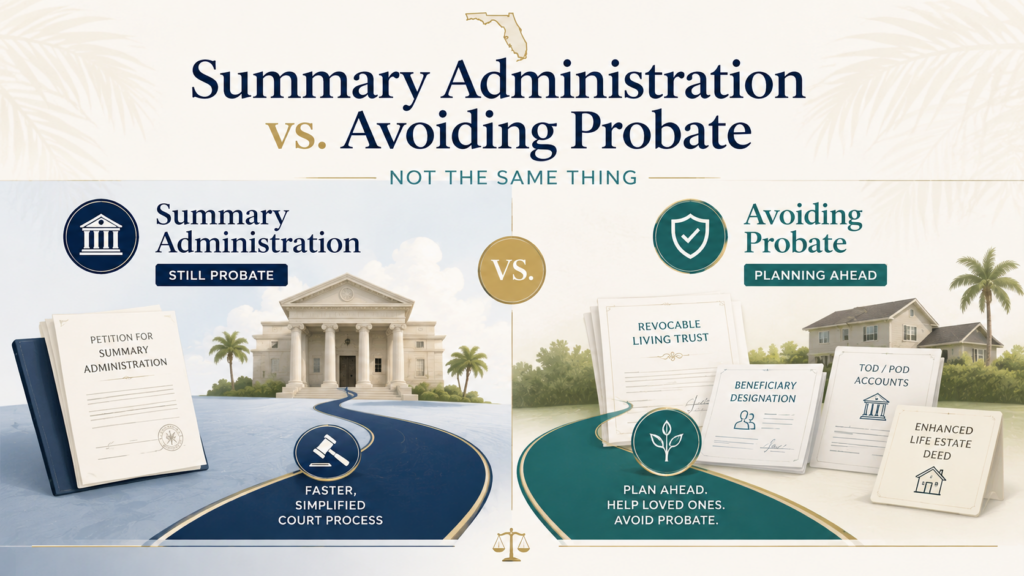
Summary administration may make probate faster, but it does not avoid probate.
Avoiding probate usually requires planning before death. That may involve tools such as a revocable living trust, properly titled accounts, beneficiary designations, enhanced life estate deeds, or other estate planning strategies.
After someone has passed away, the question is different.
At that point, the issue is usually not “How do we avoid probate?” The issue is:
What legal process is required to transfer the assets now?
For some families, the answer may be summary administration. For others, it may be formal administration. In very small estates, another simplified procedure may apply. And in some cases, certain assets may pass outside probate entirely.
The Bottom Line
Florida’s 2026 probate update may help more families qualify for summary administration by increasing the qualifying estate value from $75,000 to $150,000.
That is a meaningful change.
But probate is still fact-specific. Asset titling, beneficiary designations, creditor issues, homestead property, family agreement, and court requirements still matter.
If you recently lost a loved one and are unsure whether probate is required, the first step is to identify the assets and determine which legal process applies.
The Law Offices of Denise L. Adkins, P.A. assists families throughout Florida with probate, estate administration, inherited property issues, and related real estate matters.
If you need help determining whether summary administration, formal administration, or another probate process is appropriate, contact our office to request a consultation.
This article is for general educational purposes only and does not create an attorney-client relationship. Probate outcomes depend on the specific facts, documents, assets, and family circumstances involved.

Frequently Asked Questions About Florida Summary Administration in 2026
What is the new Florida summary administration limit in 2026?
Beginning July 1, 2026, the value limit for Florida summary administration increases from $75,000 to $150,000. This means more qualifying estates may be eligible for summary administration, which is often a faster and simpler probate process than formal administration.
Does summary administration avoid probate in Florida?
No. Summary administration is still probate. It is a simplified probate court process, but it does not avoid probate altogether. If an asset requires a court order before it can be transferred, summary administration may help provide that order more efficiently when the estate qualifies.
Does every estate under $150,000 qualify for summary administration?
No. The new $150,000 threshold does not automatically mean every estate under that amount qualifies or that summary administration is the best choice. The court may still need to consider the estate’s assets, creditor issues, homestead property, beneficiaries, heirs, title issues, and whether there are any disputes.
Does the $150,000 summary administration limit include the house?
It depends. Florida homestead property receives special legal treatment and may not be counted the same way as ordinary probate assets. However, families may still need a court order determining homestead status, especially if they want to sell the property, refinance it, satisfy a title company, or confirm who legally inherited the property.
What assets count toward the Florida summary administration limit?
Generally, the focus is on the value of the estate subject to administration in Florida, less exempt property. Assets that pass outside probate, such as accounts with valid beneficiary designations, jointly owned property with survivorship rights, or properly funded trust assets, may be treated differently. Each asset should be reviewed individually.
What is the difference between summary administration and formal administration?
Summary administration is a simplified probate process available for certain qualifying estates. Formal administration is a more involved probate process that usually includes the appointment of a personal representative. Formal administration may be necessary when the estate is larger, more complicated, disputed, or requires someone with legal authority to gather assets, communicate with institutions, sell property, or resolve creditor issues.
When might summary administration not be the right choice?
Summary administration may not be the right choice if there are disputes among heirs or beneficiaries, creditor concerns, a will challenge, unknown assets, missing heirs, unclear real estate title, business interests, property in multiple states, or a need for someone to act with authority on behalf of the estate.
Can heirs sell inherited property without probate in Florida?
Sometimes, but not always. Whether heirs can sell inherited property without probate depends on how the property was titled, whether it was homestead property, whether there was a will, who the legal heirs are, and whether a title company requires a court order. In many cases, a homestead order or probate court order may be needed before the property can be sold.
Should a family wait until July 1, 2026 to file probate?
It depends on the estate. Waiting may not be appropriate if there is a pending real estate sale, urgent property issue, creditor concern, family dispute, insurance issue, or a need to access funds. In some cases, timing may matter if the estate is close to the old $75,000 threshold and may qualify under the new $150,000 limit. Families should speak with a Florida probate attorney before deciding whether to file immediately or wait.
What if the person has been deceased for more than two years?
The two-year rule remains important. Summary administration may still be available when the decedent has been deceased for more than two years, even if the estate exceeds the dollar threshold. However, the estate still needs to be reviewed to determine the correct probate process.
Is a will enough to avoid probate in Florida?
No. A will does not avoid probate in Florida. A will tells the probate court who should receive property, but assets titled only in the decedent’s name may still need probate before they can be transferred. Avoiding probate usually requires planning before death, such as a trust, beneficiary designations, joint ownership, or other estate planning tools.
How can a Florida probate attorney help with summary administration?
A Florida probate attorney can help determine whether summary administration is available, identify which assets are probate assets, evaluate homestead issues, review creditor concerns, prepare the court filings, and help the family determine whether summary administration, formal administration, or another process is appropriate.