
Deed Planning in Florida
Before You Add a Name to the Deed, Make Sure You Understand What It Means
Transferring Florida real estate is not always as simple as signing a deed.
Many people contact us because they want to avoid probate, make things easier for their family, add a child to the deed, transfer property into a trust, or use a Lady Bird deed. Those can be valid goals. But the deed you choose can affect much more than who owns the property.
A deed can affect control, taxes, probate, title insurance, homestead rights, family disputes, creditor exposure, and what happens when someone dies.
At the Law Offices of Denise L. Adkins, P.A., we help Florida property owners look at the full picture before signing or recording a deed.
The goal is not just to move property from one name to another. The goal is to make sure the transfer fits your estate plan, your family situation, your tax concerns, your property rights, and your long-term goals.

The “Just Add My Child to the Deed” Problem
One of the most common questions we hear is:
“Can I just add my child to my deed to avoid probate?”
People usually ask this because they are trying to keep things simple. They want to avoid court. They want their children to have fewer problems after death. They may have heard from a friend, family member, online article, or non-lawyer that adding a child to the deed is an easy solution.
But adding a child to your deed can create consequences many families do not expect.
What You May Be Giving Away
When you add someone to a deed during your lifetime, you may be giving that person a present ownership interest in the property. That can affect your ability to sell, refinance, change your mind, or control what happens next.
It can also create problems if that child has creditors, gets divorced, files bankruptcy, has tax issues, dies before you, or disagrees with other family members.
And there may be tax consequences.
Tax Issues Can Follow the Transfer
If you give part of your property away during your lifetime, a gift tax return may be required. That does not always mean gift tax is owed, but it may mean the transfer needs to be reported on IRS Form 709.
There may also be capital gains consequences. When property passes at death, beneficiaries may receive different tax treatment than if the property was given away during life. If property is gifted during life, the recipient may receive the original owner’s lower cost basis instead of a basis adjustment at death. That can matter a great deal if the property has increased in value.
In other words, adding a child to a deed may avoid one problem while creating several others.
Before you add a child, spouse, relative, partner, or anyone else to your deed, it is important to understand what you are actually giving away and what legal and tax issues may follow.

Lady Bird Deeds Can Be Useful, But They Are Not Magic
A Lady Bird deed, also called an enhanced life estate deed, is a deed that may allow a Florida property owner to keep control of the property during life while naming who receives the property at death.
Lady Bird deeds are commonly used in Florida estate planning when they fit the client’s situation.
They can be a helpful tool for avoiding probate as to the specific Florida real estate described in the deed. They may allow the owner to retain the right to sell, mortgage, change beneficiaries, or revoke the arrangement during life.
But a Lady Bird deed is still just one tool.
It is not automatically the right answer for every family, every property, or every estate plan. The deed may avoid probate as to the property, but that does not mean the post-death transfer will be simple, conflict-free, or easy to administer.
A Lady Bird deed should be reviewed carefully when there are multiple beneficiaries, blended family issues, minor beneficiaries, homestead concerns, mortgage concerns, Medicaid planning questions, tax issues, family conflict, creditor concerns, addiction concerns, disability concerns, or a need for more detailed trust planning.
Sometimes a Lady Bird deed naming individual beneficiaries is a practical and efficient solution.
Sometimes a Lady Bird deed directing the property to a trust is better.
Sometimes a trust should own the property.
Sometimes the deed should be left alone.
Sometimes the problem is not the deed at all, but the larger estate plan.
That is why deed planning should begin with the question:
What are you trying to accomplish, and what could go wrong if the wrong deed is used?
Naming Individuals vs. Naming a Trust in a Lady Bird Deed
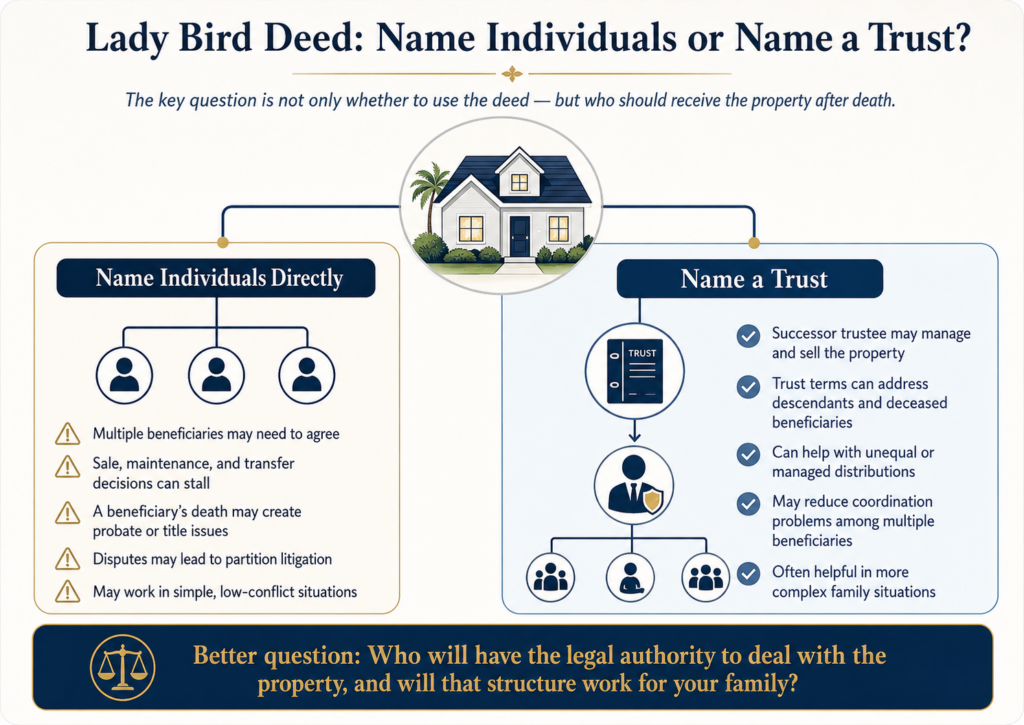
One important question in Lady Bird deed planning is not just whether to use the deed.
It is also who should receive the property after death.
Some Lady Bird deeds name individual beneficiaries directly. For example, a parent may name two or three children as the remainder beneficiaries. In a simple family situation, that may work. But in other cases, naming individuals directly can create practical problems after death.
When Multiple Beneficiaries Must Agree
If multiple people receive the property directly, they may all need to cooperate in selling, maintaining, insuring, renting, or transferring the property. That can become difficult if one person wants to sell, one person wants to live in the property, one person wants to rent it, and another person does not respond or refuses to sign.
When co-owners cannot agree, disputes can arise. In some cases, one co-owner may file a partition action to force the sale or division of the property. That can create delay, expense, and family conflict.
Another issue can arise if one of the named beneficiaries dies before the property is sold or transferred. Depending on how the deed is drafted and the facts involved, that deceased beneficiary’s interest may create additional probate or title issues. That can slow down a sale, refinance, or other handling of the property.
Why a Trust May Provide More Structure
For these reasons, some clients may prefer to have the Lady Bird deed direct the property to a revocable living trust instead of naming multiple individual beneficiaries directly.
When the property passes to a trust, the successor trustee may be able to manage the property, sell it, pay expenses, and distribute the proceeds according to the trust terms. This can be especially helpful when the plan involves multiple children, descendants of a deceased child, blended family concerns, unequal distributions, beneficiaries with personal challenges, or family members who may not work well together.
A trust may also allow the plan to address issues that a deed alone does not handle well, such as:
- What happens if a beneficiary dies before the property is sold
- Whether descendants should receive a deceased beneficiary’s share
- Whether a beneficiary’s share should be held back or managed
- Who has authority to sell the property
- How expenses should be paid before sale
- Whether one beneficiary may buy out the others
- How disputes should be handled
- Whether distributions should be delayed, protected, or structured
This does not mean every Lady Bird deed should name a trust.
If a person has one responsible adult child, a very simple estate, no family conflict, and the property is the primary asset, naming an individual beneficiary may be appropriate. But if there are multiple beneficiaries, family tension, creditor concerns, addiction concerns, disability concerns, divorce concerns, or uncertainty about whether everyone will cooperate, naming individuals directly may create problems.
The better question is not simply:
“Will this deed avoid probate?”
The better question is:
“After I am gone, who will have the legal authority to deal with the property, and will that structure actually work for my family?”
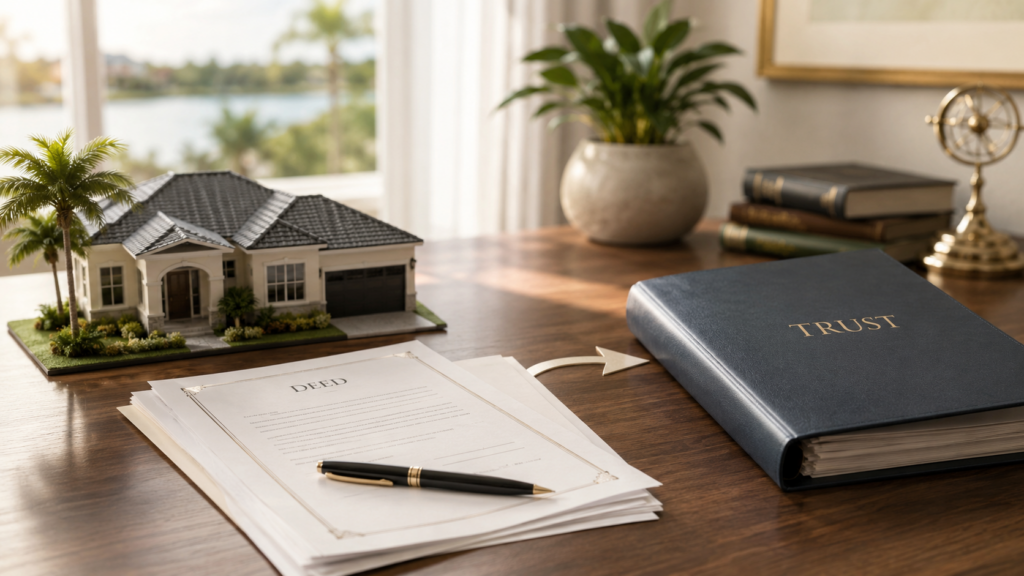
Deeds and Trust Funding
Many people create a revocable living trust because they want to avoid probate and make administration easier for their family.
But signing a trust is only part of the process.
If real estate is supposed to be owned by the trust, the property may need to be properly transferred into the trust. This is commonly called trust funding.
If the trust is signed but the deed is never prepared or recorded, the property may still be outside the trust at death. That can result in the very probate process the client was trying to avoid.
We assist clients with reviewing how their property is titled and whether a deed to a trust is appropriate as part of the overall estate plan.
This is especially important for clients who own a primary residence, rental property, inherited property, vacation property, investment property, or property that will eventually pass to children or other beneficiaries.
A trust can be a powerful planning tool, but only if the assets intended to be owned by the trust are properly coordinated with the plan.
Florida Homestead and Deed Planning
Florida homestead property requires special care.
Your primary residence may be protected in ways other property is not. But those protections also come with restrictions, especially when the owner is married or has minor children.
That means deed planning for a Florida homestead should not be treated like a simple title change.
Before changing a deed to homestead property, you should consider:
- Whether you are married
- Whether you have minor children
- Whether your spouse must sign
- Whether the deed conflicts with your will or trust
- Whether the property can legally pass the way you intend
- Whether the transfer affects your estate plan
- Whether the transfer may create a title issue later
A deed that looks simple may create problems if it does not account for Florida homestead law.
This is one reason it is important to review the deed, the estate plan, and the family situation together.
Deed Planning Is Really About Risk Planning
A deed may seem like a small document, but it can have a large legal effect.
The wrong deed can create problems such as:
- Unintended ownership rights
- Loss of control over the property
- Family disputes after death
- Avoidable probate issues
- Gift tax reporting concerns
- Capital gains tax consequences
- Loss of potential step-up in basis
- Homestead complications
- Creditor or divorce exposure for the new owner
- Problems selling or refinancing the property
- Title insurance issues
- Confusion between a deed, will, and trust
The right deed depends on the facts.
That includes who owns the property now, whether the property is homestead, whether there is a mortgage, whether the owner has a trust, who should receive the property at death, whether there are multiple children, whether there is a blended family, and whether there are tax or creditor concerns.
A deed should not be prepared in isolation.
It should fit the plan.
Common Reasons Clients Need Deed Planning

Clients often come to us for deed planning when they are:
- Trying to avoid probate
- Considering a Lady Bird deed
- Funding a revocable living trust
- Adding or removing someone from title
- Transferring property between family members
- Transferring property after marriage, divorce, or death
- Correcting a prior deed
- Dealing with inherited property
- Planning for children or beneficiaries
- Transferring property to or from an LLC
- Preparing to sell or refinance property
- Reviewing whether their current deed matches their estate plan
Sometimes the best answer is to prepare a new deed.
Sometimes the best answer is to use a trust.
Sometimes the best answer is to leave title alone and solve the issue another way.
Good deed planning helps you choose the right tool instead of simply grabbing the most familiar one.
Why a Cheap Deed Can Become Expensive
Online deed forms and low-cost deed services may look appealing, especially when the goal seems simple.
But deed work is not just typing names into a form.
A properly planned deed should consider the legal description, ownership structure, marital status, homestead, taxes, probate, estate planning documents, recording requirements, title history, and the reason for the transfer.
The Problem May Not Show Up Right Away
A deed that is poorly planned or incorrectly prepared may not cause a problem immediately.
The problem may show up years later, when someone dies, the property is sold, the family disagrees, a title company raises an issue, or a beneficiary discovers that the tax result is very different from what everyone expected.
By then, fixing the problem may be more expensive than doing it correctly in the first place.
Questions to Ask Before Signing a Deed
Before signing or recording a deed, ask:
- Am I giving away ownership during my lifetime?
- Will I still be able to sell or refinance the property?
- Could this create a gift tax reporting issue?
- Could this affect capital gains taxes later?
- Could my family lose a potential step-up in basis?
- Does this deed avoid probate as to this specific property, or could it create a different probate problem?
- Does this deed match my trust or will?
- What happens if the person I add gets divorced, sued, or dies before me?
- Is a Lady Bird deed appropriate, or is a trust better?
- Is this property my homestead?
- Is there a mortgage or lender issue?
- Will this create conflict among my children or beneficiaries?
If you do not know the answer to those questions, it is worth getting legal guidance before the deed is signed.
Frequently Asked Questions About Deed Planning in Florida
Can I add my child to my deed to avoid probate in Florida?
You may be able to add a child to a deed, but that does not mean it is the best option. Adding a child during your lifetime may give that child a present ownership interest and may create tax, creditor, divorce, control, and family conflict issues. A Lady Bird deed, trust, or other planning option may be more appropriate depending on the facts.
Does a Lady Bird deed avoid probate in Florida?
A properly prepared Lady Bird deed may help avoid probate for the specific Florida property described in the deed. However, it does not avoid probate for other assets that remain titled in the deceased person’s individual name. It should be coordinated with the rest of the estate plan.
Is a Lady Bird deed better than a trust?
Sometimes yes, sometimes no. A Lady Bird deed may be efficient for certain real estate transfers. A trust may be better when there are multiple beneficiaries, blended family issues, minor beneficiaries, incapacity concerns, multiple properties, or a need for more detailed instructions.
Can I transfer my house into my revocable trust?
In many cases, Florida real estate can be transferred into a revocable living trust, but the deed should be reviewed carefully before recording. Homestead status, mortgage issues, title insurance, estate planning goals, and tax concerns should be considered first.
Will adding someone to my deed create a tax problem?
It may. Adding someone to a deed during your lifetime may be treated as a gift and may require gift tax reporting. It may also affect the recipient’s basis in the property and future capital gains consequences. You should speak with legal and tax professionals before transferring an interest in appreciated real estate.
What should I do before signing a deed?
Before signing a deed, make sure you understand who will own the property, whether you are giving away control, how the deed affects probate, whether it matches your will or trust, whether it creates tax issues, and whether it affects Florida homestead rights.
Our Approach
At the Law Offices of Denise L. Adkins, P.A., we help clients make informed decisions about Florida real estate transfers.
We do not treat deeds as one-size-fits-all forms.
We review the purpose of the transfer, the current title, the family situation, the estate plan, the tax-sensitive issues, and the potential risks. Then we help determine which tool makes the most sense.
That may involve a Lady Bird deed, a deed to a trust, a corrective deed, a family transfer deed, an LLC-related deed, or another planning approach.
The right solution depends on the facts.
Our goal is to help you evaluate options that may reduce unnecessary probate, lower the risk of future conflict, reflect your intentions, and coordinate the deed with the rest of your legal plan.
Schedule a Deed Planning Consultation
If you are thinking about adding someone to a deed, using a Lady Bird deed, transferring property into a trust, correcting a deed, or changing how Florida real estate is titled, speak with an attorney before you sign.
A deed can be simple to record but difficult to unwind.
Contact the Law Offices of Denise L. Adkins, P.A. to schedule a consultation about deed planning, probate avoidance, trust funding, and Florida real estate transfers.
