
Federal law may require a 401(k) to pass to a spouse — even if the account owner intended the funds for their children.
Tweet
Summary
Federal law may require a 401(k) to pass to a spouse even if children are named as beneficiaries. This article explains how ERISA rules can override beneficiary designations and why blended families should carefully review retirement account planning.
One issue that often surprises families involves retirement accounts, particularly 401(k) plans.
A recent situation that crossed our desk illustrates how easily estate planning intentions can be unintentionally defeated by federal law.
Many people assume they can name anyone they want as the beneficiary of a 401(k). However, federal retirement plan rules sometimes require the account to pass to a surviving spouse unless that spouse signs a written waiver.
A Situation That Happens More Often Than People Realize
In this situation, a parent in a second marriage wanted her children from a prior relationship to receive her retirement savings.
Her plan was thoughtful.
She arranged for her spouse to receive a life estate in the marital home, allowing the spouse to live there for life. After the spouse passed away, the home would go to her children.
At the same time, she intended for her 401(k) retirement account, worth approximately $500,000, to go directly to her children.
However, an important legal rule applied that she did not realize.
Because the account was a 401(k) governed by federal law, the surviving spouse became entitled to the retirement account.
As a result, the children ultimately received only a future remainder interest in the marital home, while the retirement account passed to the spouse.
The Federal Rule Many People Do Not Know About
Many employer-sponsored retirement plans, including most 401(k) plans, are governed by the federal Employee Retirement Income Security Act (ERISA).
Under ERISA, a married participant’s spouse is generally the default beneficiary of a 401(k) plan.
Even if the account owner names someone else as the beneficiary, federal law may require the plan to pay the account to the spouse unless the spouse formally signs a written waiver consenting to another beneficiary.
These spousal protections were designed to prevent a surviving spouse from being unintentionally disinherited.
However, in blended family situations, this rule can sometimes create unexpected results.
Authoritative sources discussing these rules include:
These federal provisions generally require spousal consent before a married participant can name someone other than their spouse as beneficiary of certain retirement plans.

Why an IRA Can Be Different
Not all retirement accounts operate under the same rules.
Many employer-sponsored retirement plans, such as 401(k) plans, are governed by the federal Employee Retirement Income Security Act (ERISA). Under ERISA, a surviving spouse is generally entitled to certain retirement plan benefits unless the spouse signs a written waiver consenting to a different beneficiary.
Individual Retirement Accounts (IRAs) are typically not subject to these same ERISA spousal consent requirements.
Because of this distinction, the structure of a retirement account can sometimes affect how assets ultimately pass to heirs.
For this reason, retirement accounts should always be reviewed and coordinated carefully as part of an overall estate plan.

Estate Planning for Blended Families Requires Careful Coordination
Situations involving:
- second marriages
- children from prior relationships
- retirement accounts
- life estates
- beneficiary designations
can create complex planning issues.
Wills, trusts, beneficiary forms, and retirement plan rules must often be carefully aligned to ensure assets pass according to a person’s wishes.
Without proper planning, federal retirement plan rules may produce results that differ from what the account owner intended.
Final Thoughts
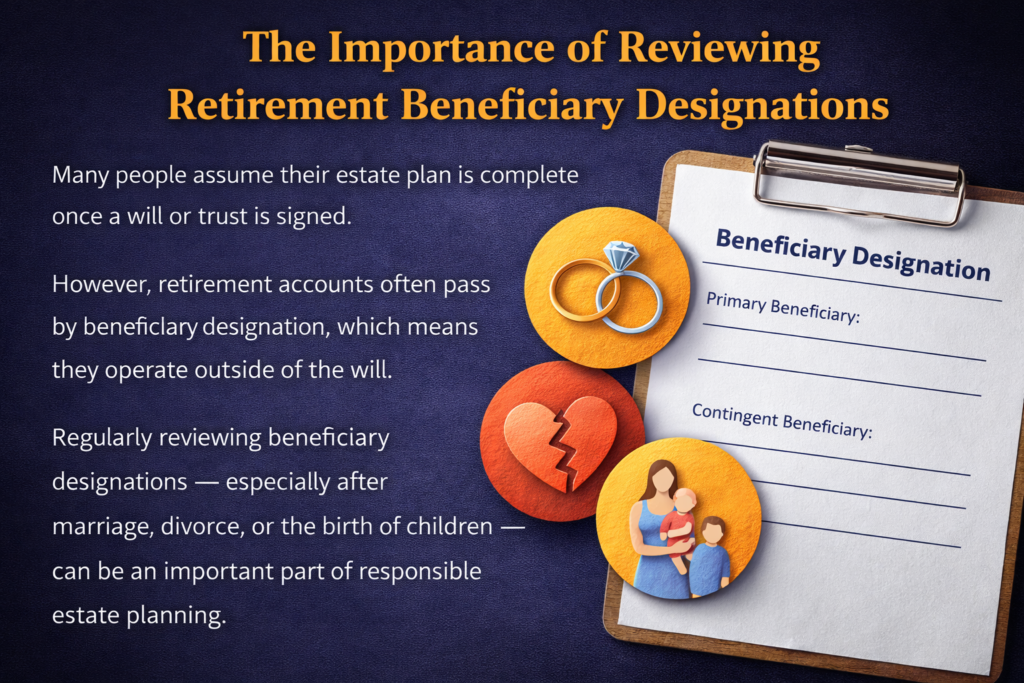
Estate planning is not only about drafting documents. It is also about ensuring that retirement accounts, beneficiary designations, and estate planning documents all work together.
For families with blended relationships, careful planning can help avoid unintended consequences.
Anyone with retirement accounts and a blended family structure may benefit from discussing their situation with an experienced estate planning attorney.
Speak With an Estate Planning Attorney
Retirement accounts are one of the most commonly misunderstood parts of estate planning. As this example illustrates, federal law and beneficiary designation rules can sometimes produce results very different from what a person intended.
For individuals in second marriages or blended family situations, coordinating retirement accounts, beneficiary designations, wills, and trusts is particularly important.
A careful review of your estate plan can help ensure that your assets are structured to pass according to your wishes and that important details—such as retirement account beneficiary rules—are properly addressed.
If you have questions about retirement accounts, beneficiary designations, or estate planning for blended families, you may wish to discuss your situation with an experienced estate planning attorney.
Request a consultation to review your estate plan and retirement beneficiary designations.