SUMMARY: Florida real estate law changes in 2026 may affect investors, landlords, builders, flippers, small developers, and property owners planning residential improvements. While many investors focus on interest rates, insurance premiums, property taxes, rental demand, and construction costs, changes to Florida law can also affect timing, risk, due diligence, and investment strategy.This article highlights several 2026 Florida real estate updates involving building permits, HOA review, development approvals, land use regulations, manufactured and off-site constructed housing, and rental fraud. These changes may create opportunities, but investors should still carefully review permit history, zoning, title issues, HOA restrictions, rental procedures, and local requirements before buying, renovating, leasing, or developing property in Florida.
Florida real estate law changes in 2026 may affect investors, landlords, builders, flippers, small developers, and property owners planning residential improvements. While many investors focus on interest rates, insurance premiums, property taxes, rental demand, and construction costs, legal changes can also affect the numbers.
In 2026, Florida approved several real-estate-related laws involving building permits, HOA review, development approvals, manufactured and off-site constructed housing, and rental fraud. This article explains the updates most likely to matter to residential real estate investors and property owners in Florida.
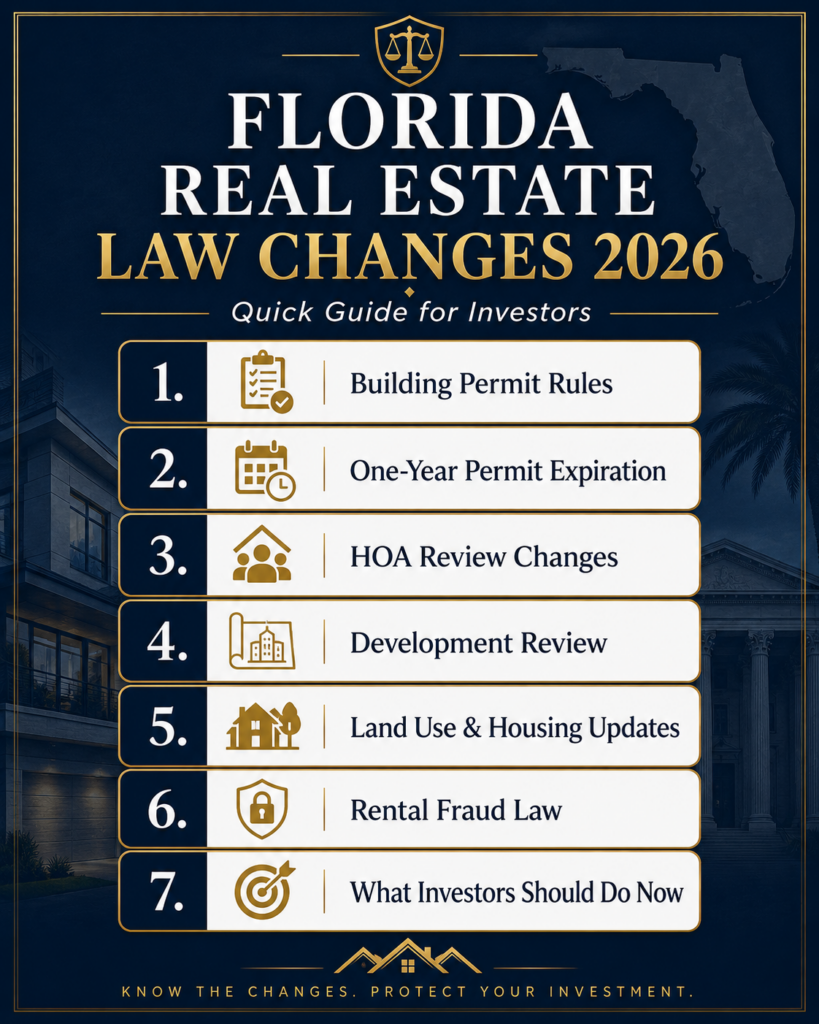
1. Florida’s Building Permit Rules Are Changing
One of the most practical 2026 changes for real estate investors is Florida’s new building permit and inspection law.
For investors, this may matter when evaluating:
- fix-and-flip projects;
- pre-listing repairs;
- post-closing renovations;
- rental property improvements;
- small contractor work;
- due diligence on unpermitted work;
- repair credits and closing negotiations.
Under the new law, certain work on a single-family dwelling valued under $7,500 may be exempt from local building permit requirements. However, this does not mean every project under $7,500 is automatically permit-free.
The law includes important exceptions. Permits may still be required for electrical, plumbing, mechanical, gas, structural work, and work in certain flood hazard areas. Owners and contractors also may not divide a larger project into smaller pieces just to fall below the dollar threshold.
Why this matters for investors
For investors, this change may reduce delays for some smaller residential repairs, but it also creates a new due diligence issue.
A buyer, seller, investor, or lender may still need to ask:
- Was the work actually exempt?
- Was the project improperly split into smaller pieces?
- Did the work involve electrical, plumbing, mechanical, gas, or structural components?
- Is the property in a flood hazard area?
- Will the work create inspection, insurance, appraisal, or resale issues later?
The practical takeaway is simple: fewer permits may be required for certain small projects, but investors should not assume “no permit” means “no legal risk.”
2. Building Permits for Single-Family Dwellings Will Have a One-Year Expiration Rule
HB 803 also provides a one-year expiration period for certain building permits issued for single-family dwellings, or until the effective date of the next edition of the Florida Building Code, whichever is later.
For investors, this may matter when buying property with open permits or when taking over a stalled construction or renovation project.
Before closing, investors should confirm:
- whether any permits are open;
- whether any permits are expired or close to expiration;
- whether inspections remain outstanding;
- whether work was completed but never closed out;
- whether permit issues could delay resale, refinancing, insurance, or future renovations.
Open and expired permits are not just paperwork problems. They can affect closings, title review, municipal lien searches, code compliance, and negotiations between buyers and sellers.
3. HOAs Cannot Require a Building Permit Before Reviewing Certain Construction Requests
Another investor-relevant piece of HB 803 involves community associations.
The law prohibits an association or certain committees from requiring a building permit as a prerequisite before reviewing certain construction or improvement requests.
This matters for investors buying, renovating, or reselling homes in HOA communities. In practice, some investors face a timing problem: the HOA wants permits before architectural review, while the permitting authority may require plans or approvals before moving forward. The new law appears designed to reduce that circular delay.
However, this does not mean an HOA loses architectural review authority altogether. Investors should still review the declaration, architectural guidelines, use restrictions, leasing restrictions, and approval procedures before buying or improving property in a deed-restricted community.
For investor-owned property, the bigger point is this: HOA restrictions can still affect renovation timelines, rental strategy, resale value, and exit planning.
4. Local Development Review Is Being Streamlined
Florida also approved HB 927, which became Chapter 2026-64, Laws of Florida, and takes effect July 1, 2026.
This law affects local land planning and development review. It requires certain counties and municipalities to create a program allowing qualified, preapproved private professionals to perform preapplication review services for certain permit applications, plan reviews, and plat approvals.
For small developers, builders, land investors, and investors assembling property for future development, this may matter because local review delays can significantly affect carrying costs.
The investor issues include:
- entitlement timelines;
- subdivision or plat approval timing;
- redevelopment planning;
- infill housing opportunities;
- land acquisition due diligence;
- private-provider review options;
- local government processing delays.
This does not mean every development project will be approved faster. It also does not eliminate zoning, concurrency, environmental review, comprehensive plan issues, or local development standards. But it does reflect Florida’s continued push toward more predictable development review.
5. Land Use and Development Regulations Were Also Updated in 2026
Florida also approved HB 399, which became Chapter 2026-7, Laws of Florida.
This law addresses several land use and development regulation issues, including development permit fees, certain public easement and right-of-way matters, compatibility standards for certain residential uses, manufactured buildings, off-site constructed residential dwellings, and requirements that local government regulations be reasonable and uniformly enforced.
For investors, the most relevant point is that Florida continues to move toward more uniform treatment of certain residential housing products and development applications.
This may be relevant to investors considering:
- manufactured housing;
- mobile home park investments;
- off-site constructed residential dwellings;
- infill residential development;
- workforce housing;
- redevelopment of underused residential parcels;
- projects affected by local compatibility standards.
As with all land use matters, investors should still evaluate the specific property, zoning district, future land use designation, recorded restrictions, municipal code, county code, utility availability, access, easements, flood zone, and development history before relying on a projected use.
6. Rental Fraud and “Fraudulent Entry” May Become a Major Landlord Issue
One of the most interesting investor-related proposals in 2026 is HB 1293, dealing with fraudulent entry of residential dwellings.
As of the date of this article, HB 1293 had passed the Legislature and was ordered enrolled, but investors should confirm final approval status before relying on it as law.
If it becomes law as proposed, the bill would create the concept of fraudulent entry into a residential dwelling unit. In general terms, the bill addresses situations where a person obtains possession of a rental unit through false written statements, false identity information, false financial information, false documents, or impersonation.
The bill would also make fraudulent entry a basis for landlord action under Florida’s residential landlord-tenant statute.
For landlords and property managers, this is important because rental fraud is not just a leasing inconvenience. It can create lost rent, eviction costs, property damage, insurance issues, delay in re-renting the property, and practical difficulty regaining possession.
Whether or not this bill is signed into law, Florida landlords should already be reviewing their tenant-screening process, rental applications, lease documents, identity verification practices, move-in procedures, and fraud prevention protocols.
7. What Florida Real Estate Investors Should Do Now
Legal changes do not replace due diligence. They change what good due diligence should include.
Florida real estate investors should consider reviewing:
- purchase contracts;
- inspection periods;
- permit history;
- open and expired permits;
- municipal lien searches;
- HOA and condo documents;
- rental restrictions;
- leasing procedures;
- tenant-screening policies;
- contractor agreements;
- repair scopes;
- development timelines;
- title exceptions;
- survey issues;
- zoning and future land use.
The biggest mistake investors make is treating legal review as something that happens only after a problem appears. By then, the issue may already be expensive.
Final Takeaway
Florida’s 2026 real estate updates may create opportunities for investors, especially in permitting, small residential improvements, development review, and housing-related land use. But they also create new due diligence questions.
A faster repair process does not eliminate permit risk. A streamlined development review process does not guarantee approval. A potential rental fraud statute does not replace careful tenant screening. And HOA or local government rules still need to be reviewed before an investor commits money to a property.
For Florida real estate investors, the best strategy is not simply to react to new laws. It is to build legal review into the investment process before closing, before construction, before leasing, and before a dispute begins.
If you are buying, renovating, leasing, or developing residential investment property in Florida, our firm can help with real estate contracts, title review, closing issues, permit concerns, and legal due diligence before problems become expensive.
Considering a Florida Real Estate Investment, Renovation, or Rental Issue?
Florida real estate laws can affect more than the purchase price. Permit history, open permits, HOA restrictions, title issues, lease documents, zoning, and local requirements can all affect the value, timing, and risk of a transaction.
If you are buying, renovating, leasing, selling, or developing residential investment property in Florida, the Law Offices of Denise L. Adkins, P.A. can help you review the legal issues before they become expensive problems.
Request a consultation or call/text (407) 337-3377 to discuss your Florida real estate matter.